TABLE OF CONTENTS
- Intro
- Accessing
- Running your searches
- Understanding the results count
- Understanding the Search Scopes
- Managing the Results Grid
- Saving your searches
- More menu Options
- Customizing Search Fields & Filter Views
Intro
The Advanced Project Search is your central hub for filtering, reporting, and performing bulk updates on your database. Whether you need to locate specific types of jobs, track resource utilization, or update hundreds of entries at once, this advanced search allows you to slice and dice your project and booking data with precision.
You can build specific search queries using:
- Categories: Containers, Projects, Binders, Bookings, Project Work Orders, Media Orders or Task Bookings.
- Standard fields: Company name, Project name, Status, Date ranges, and more.
- Custom Fields: Any Custom Field you created for your projects or bookings automatically becomes a searchable parameter here.
Real-world use cases
Depending on your workflows and database configurations, you can use this advanced search for:
- Tracking: Monitor current active projects for specific clients, track the invoice status of a project, export a list of a certain producer's projects, or track shoots from a specific location for a given timeframe.
- Reporting: Find out your revenue for a given quarter, analyze how much was spent by a specific client in a given month, see the total value of booked hours for next month, or calculate how many hours of a certain Service were completed during a given period.
To generate a Financial Report: Select the desired items in your search results, right-click (Ctrl+click on Mac), and choose Financial Reports On....
Accessing
To access the advanced search panel, click on Projects on the main Navigation Bar at the top of the farmerswife Client app.
Can't see the Projects tab?
- Check your layout: Go to your Toolbox > Settings > Display > Module Bar Setup and ensure Projects is checked (this is a per-user configuration).

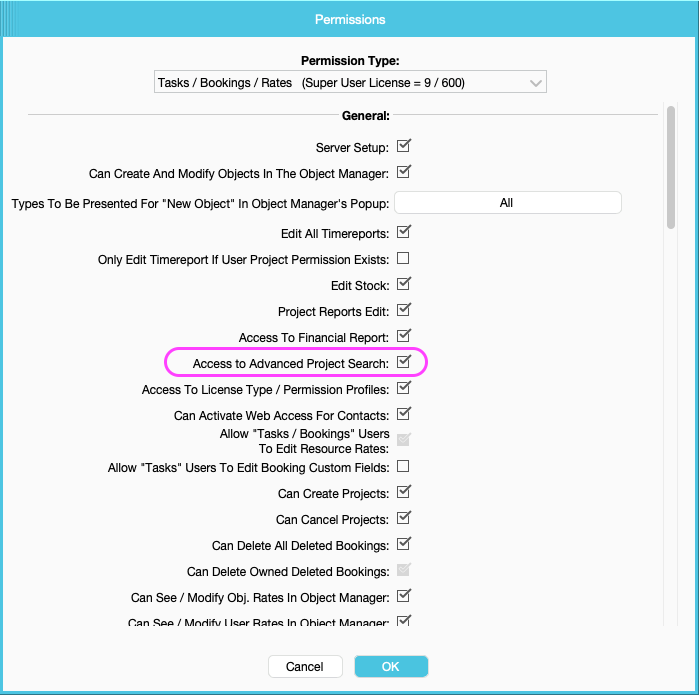
- Check your permissions: If it's still missing, your system administrator needs to enable Access to Advanced Project Search in your User Permission Profile (via Server Setup or Object Manager). If updated via the Object Manager, you must log out and back in for changes to take effect.
Running your searches
Step 1: Set Your Search Scope (Filter From)
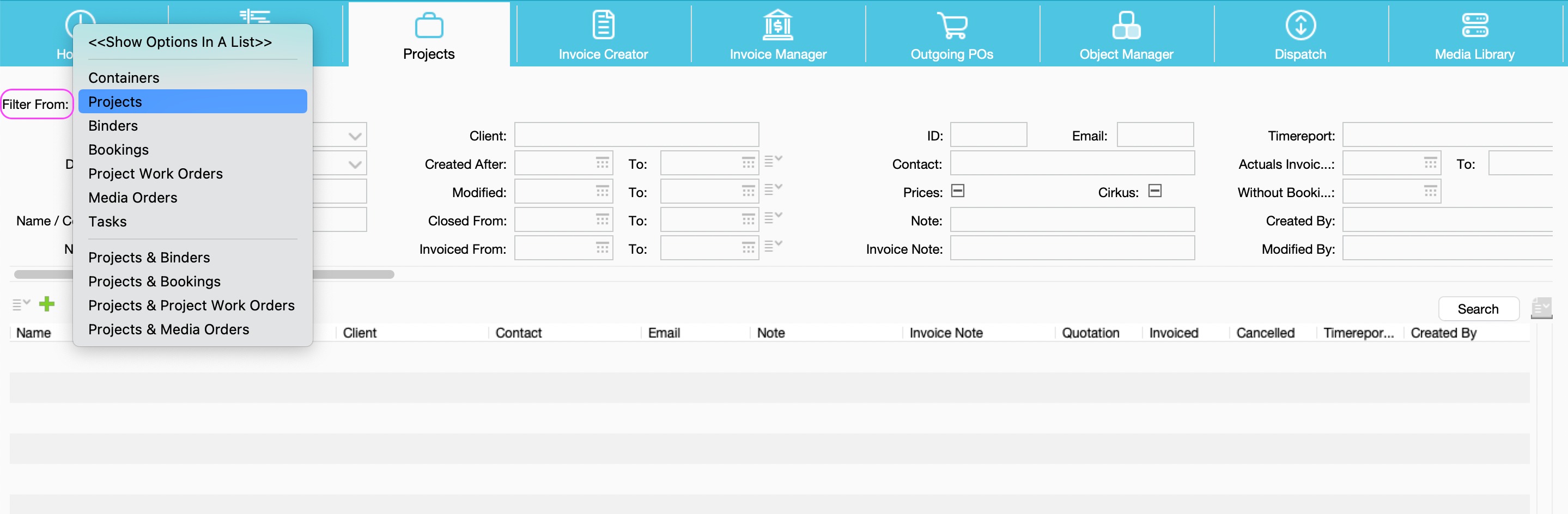
Before typing anything, you must select an option from the Filter From dropdown.
The Golden Rule: The option you choose here completely transforms your search panel. It dynamically changes your available search filters, your results grid columns, and ensures that 1 row in your results equals 1 matching item of that specific category.
For a detailed breakdown of each option, see Understanding the Search Scopes section below.
Step 2: Enter Your Filters
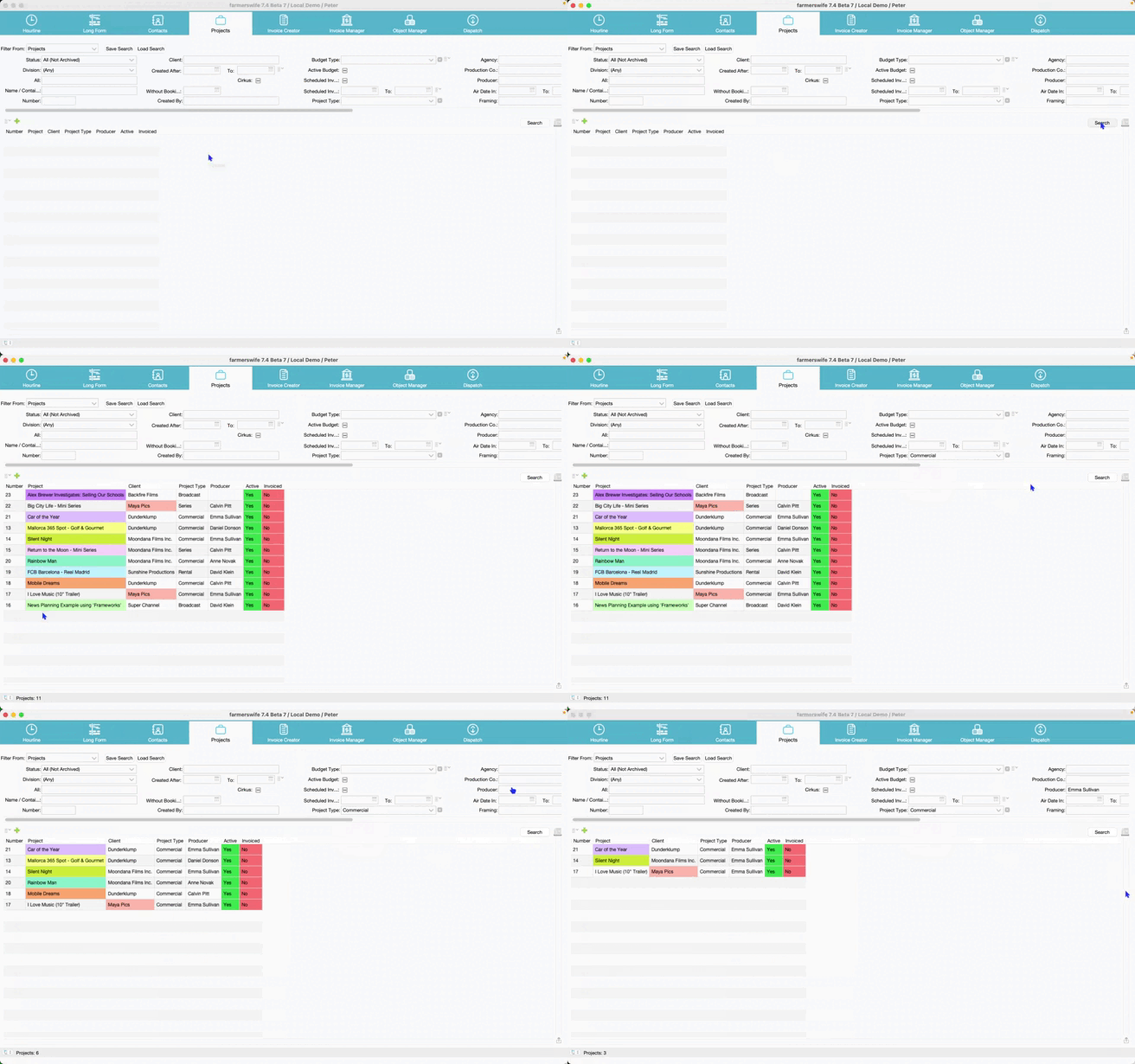
Type your search criteria into the top panel. You can search by standard information (Project name, Company, Binder, or date ranges) or target specific Custom Fields.
You can customize which fields you want to see/hide in your filters. See the Customizing Search Fields section below.
Step 3: Execute and View Results
Press the Search button (or hit Enter on your keyboard). Your matching data will instantly populate the results grid at the bottom.
Understanding the results count
At the very bottom-left corner, you will see a small summary bar displaying specific counts. These figures show exactly how much data your active search filters are returning out of your system's total pool.
When utilizing combined search scopes like Projects & Bookings, the status bar breaks down your results into two distinct sets of figures separated by a slash /.
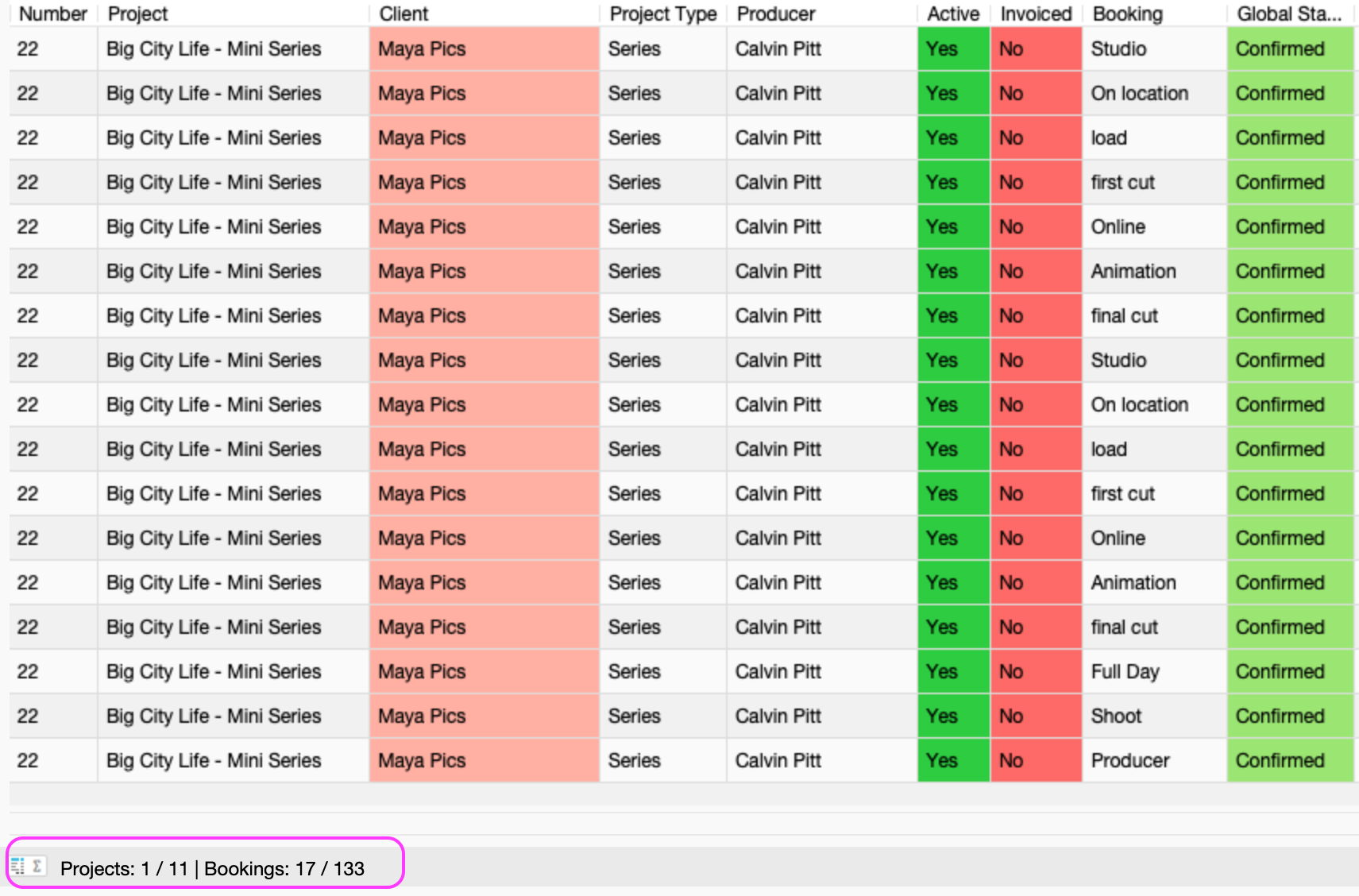
This example shows Projects: 1 / 11 | Bookings: 17 / 133.
The First Number (Displayed Rows): Shows how many unique records match your explicit search criteria and are currently displayed in the grid. In the screenshot, only 1 Project and 17 Bookings match the specific search criteria.
The Second Number (Total Active Pool): Shows the total number of records that exist in your system for that category before applying your text or keyword filters (governed by your broader status settings like "All Not Archived"). In the screenshot, there are 11 Projects and 133 Bookings in the overall pool.
Why is this useful?
This status bar acts as a quick health check for your query. If you expect to see a specific booking but your rows are empty, looking at the status bar allows you to instantly see if the item is blocked by a restrictive keyword/date filter, or if it isn't part of the active search pool at all.
Understanding the Search Scopes
Below is a detailed breakdown of what each individual and combined scopes returns along with their unique search behaviours.
1. Containers
What it returns: A list of project Containers.
Best used for: High-level organization and tracking top-level container metadata.
2. Projects
What it returns: A list of individual Projects.
Searchable variables: All standard fields that you see within the Project window (such as Client, Created By, Creation Date, etc.), fields related to the Budget module (to find specific Budget Types and if projects have Active Budgets), and any Project Custom Fields you have configured.
Important Date Logic:
Creation Date: Triggers on the exact date/time a user created the project.
Modification Date: Only updates when editing standard Project Fields (e.g., changing the Project Status or Client). Changes to nested Bookings, Extras, Media Orders, or Work Orders will not affect this date.
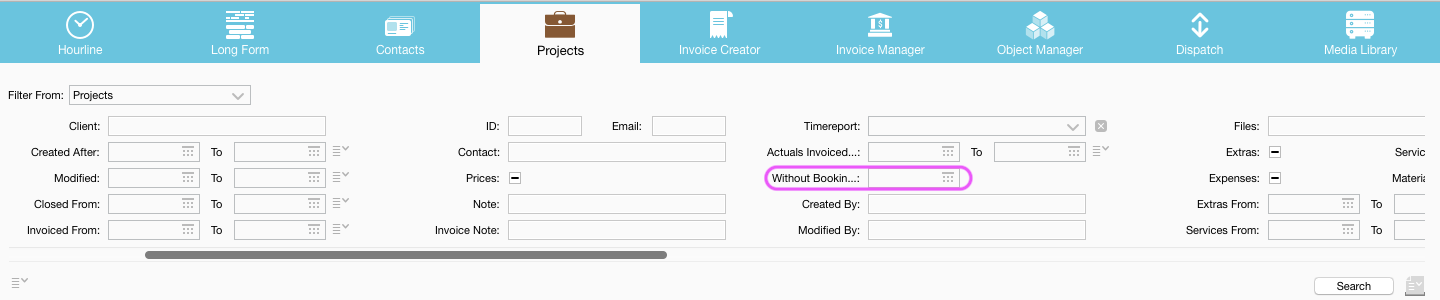
Without Bookings After Date: Shows only projects that have no scheduled bookings after the specified date. Excellent for identifying dormant or inactive jobs that are ready to be closed or archived.
3. Binders
What it returns: A list of Binders.
Searchable variables: Binder Name, Sub-Binders, Notes, Creation and Modification date ranges, and Binder Custom Fields.
4. Bookings
What it returns: A list of individual scheduled Bookings.
Searchable variables: All standard fields for Bookings (such as Number, if it has been invoiced, if it belongs to a Binder, etc.), and any Project Custom Fields you have configured.
Some Advanced Filtering:
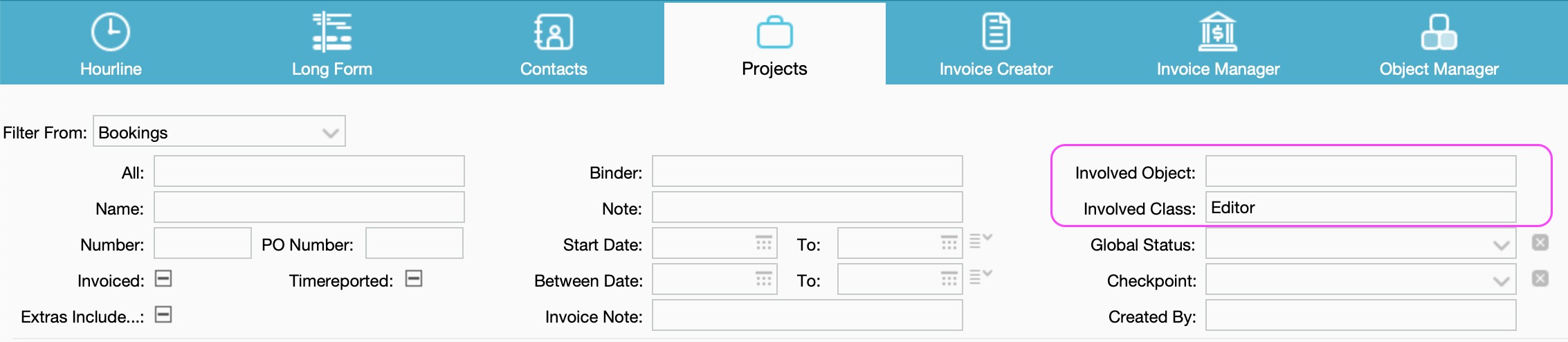
Involved: You can search directly by Involved Objects (specific resources/crew) or Involved Classes (resource categories like "Senior Editors").
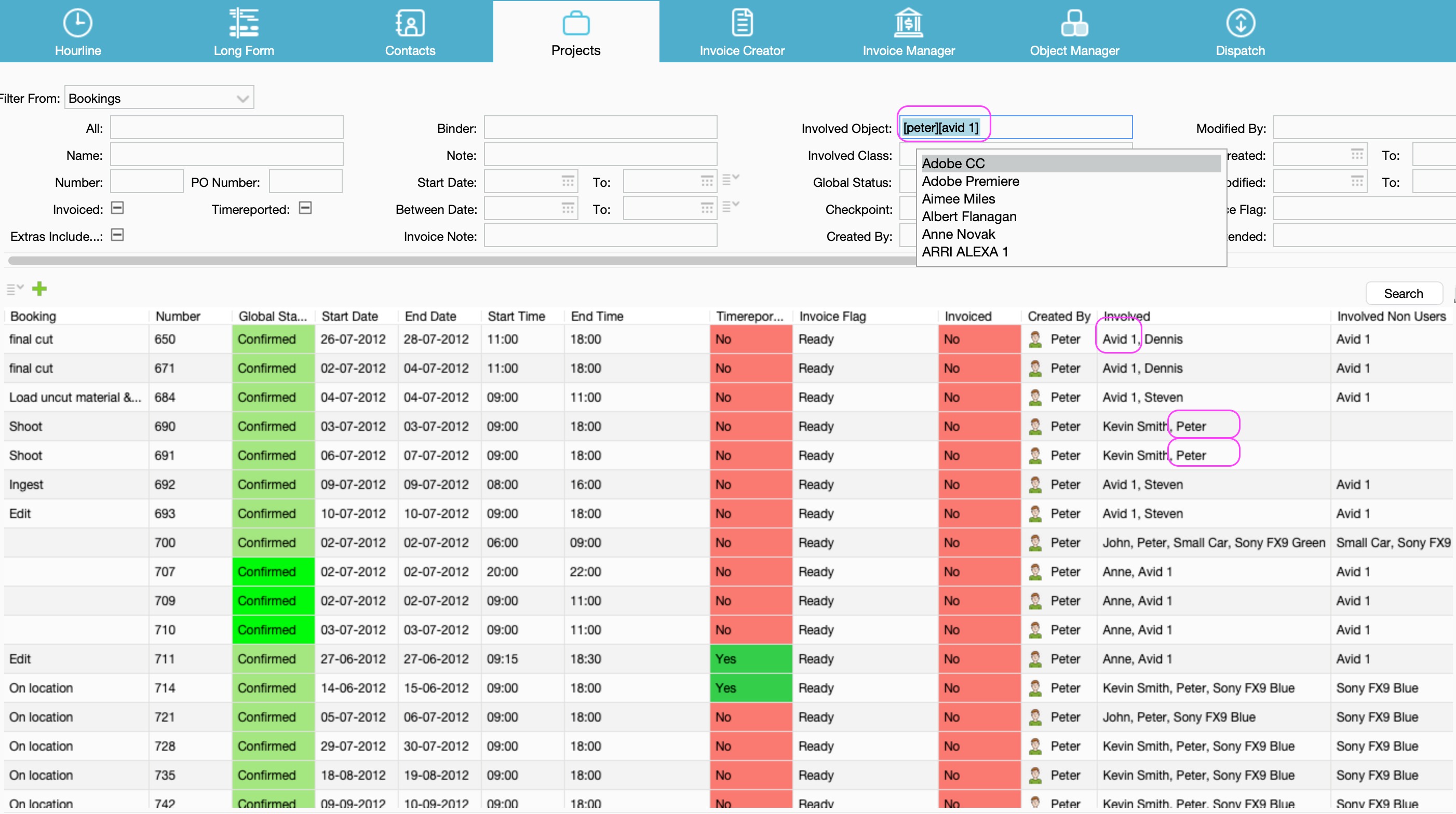
You can enclose multiple involved objects inside square brackets []. For example, entering [Editor 1] [Editor 2] will return any booking that includes any of them.
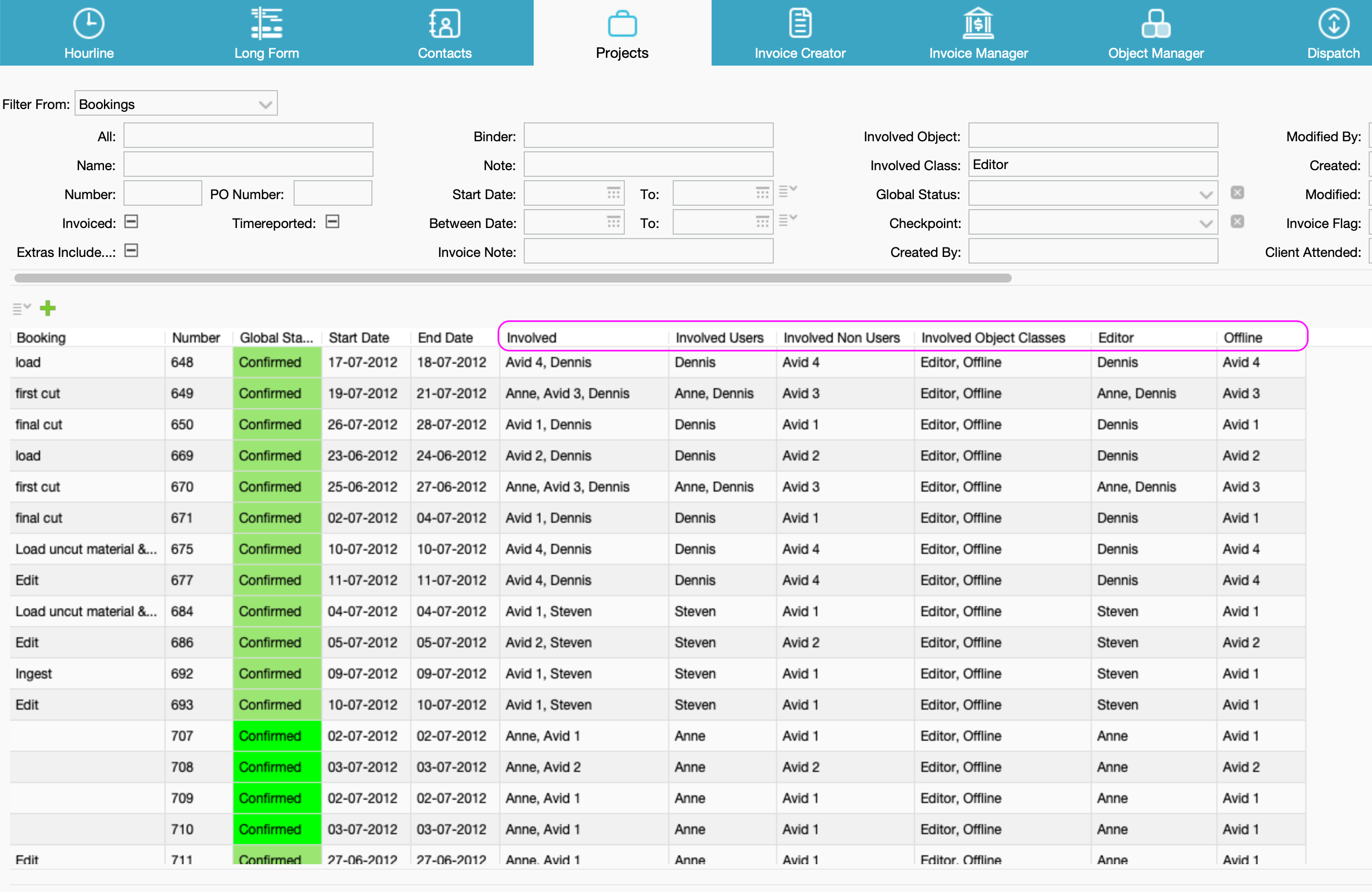
Additionally in the Edit View (see Choosing your columns section below), it's possible to add these specific columns:
- Involved (listing all involved, comma separated)
- Involved Users (listing users, comma separated)
- Involved Non-Users (listing other objects, comma separated)
- Involved Object Classes (listing object classes, comma separated)
- Selected Object Classes, which show who is involved from that class (list specific objects of that class involved in the booking)
5. Project Work Orders
What it returns: A list of Work Orders.
Searchable variables: Standard fields like Work Order Name, Assigned To, and Work Order Custom Fields.
6. Media Orders
What it returns: A list of Media Orders.
Searchable variables: Media Order Name, Assigned To, and Media Order Custom Fields.
7. Tasks
What it returns: Task Bookings.
Note: These are independent tasks that are not linked to any specific Project. You can search by Task Name, Creation Date, and Task Custom Fields.
8. Combined Scopes: Projects & [Sub-Category]
When you choose a combined filter (such as Projects & Bookings, Projects & Binders, Projects & Media Orders, or Projects & Work Orders), the layout changes dramatically:
- Dual Search Panels: The top area splits into two search panes. The left pane handles your Project-level filters, and the right pane handles your sub-category filters (e.g., Booking details or Work Orders).
- How the Filtering Works: farmerswife will first isolate the Projects that match your left-pane criteria, and then search within those specific projects to find the specific sub-items matching your right-pane criteria.
- Results: The results grid displays one row per matching sub-item. Because of this, the main Projects information will repeat into multiple rows if it contains multiple Booking or Media Orders or Work Orders that match your criteria.
Some special search logic:
- Binders: When searching for a Binder Name under the Projects & Bookings scope, the system automatically drills down to return bookings from the main parent binder, as well as any bookings nested inside its Sub-Binders
(Available from version 7.4 onwards).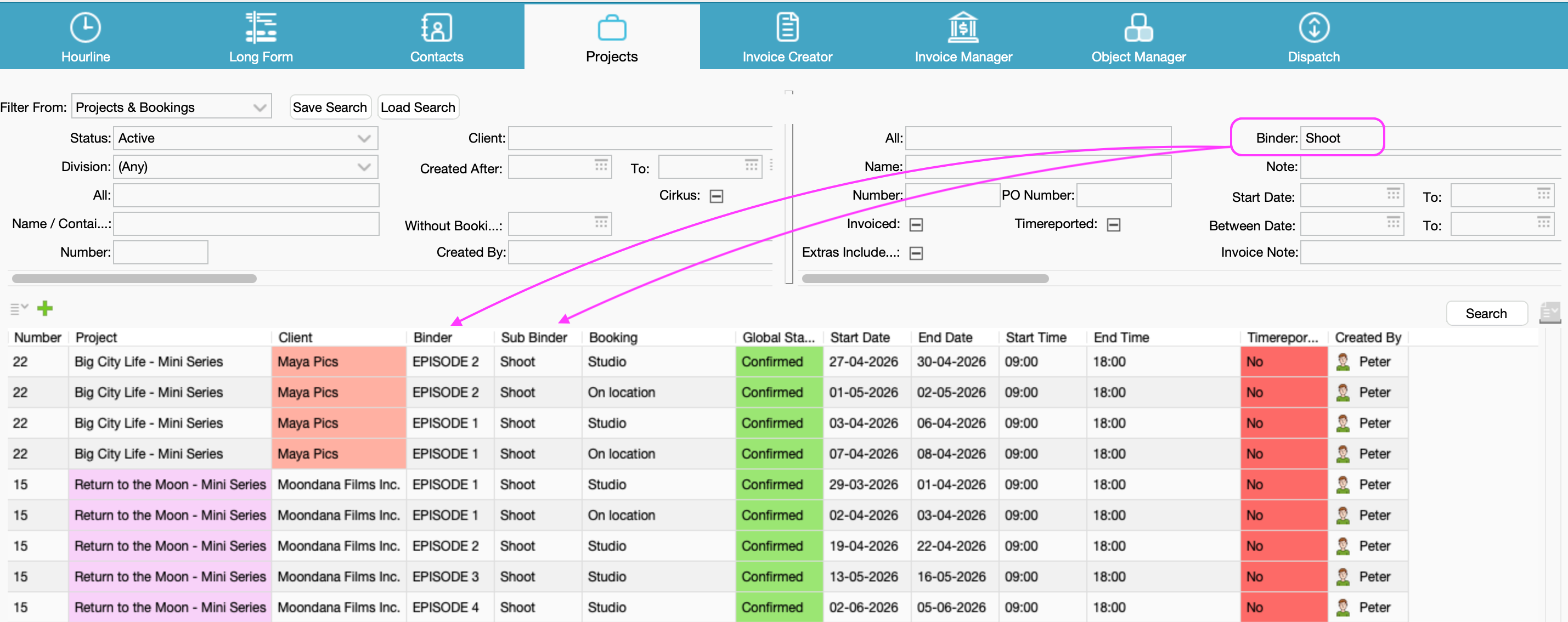
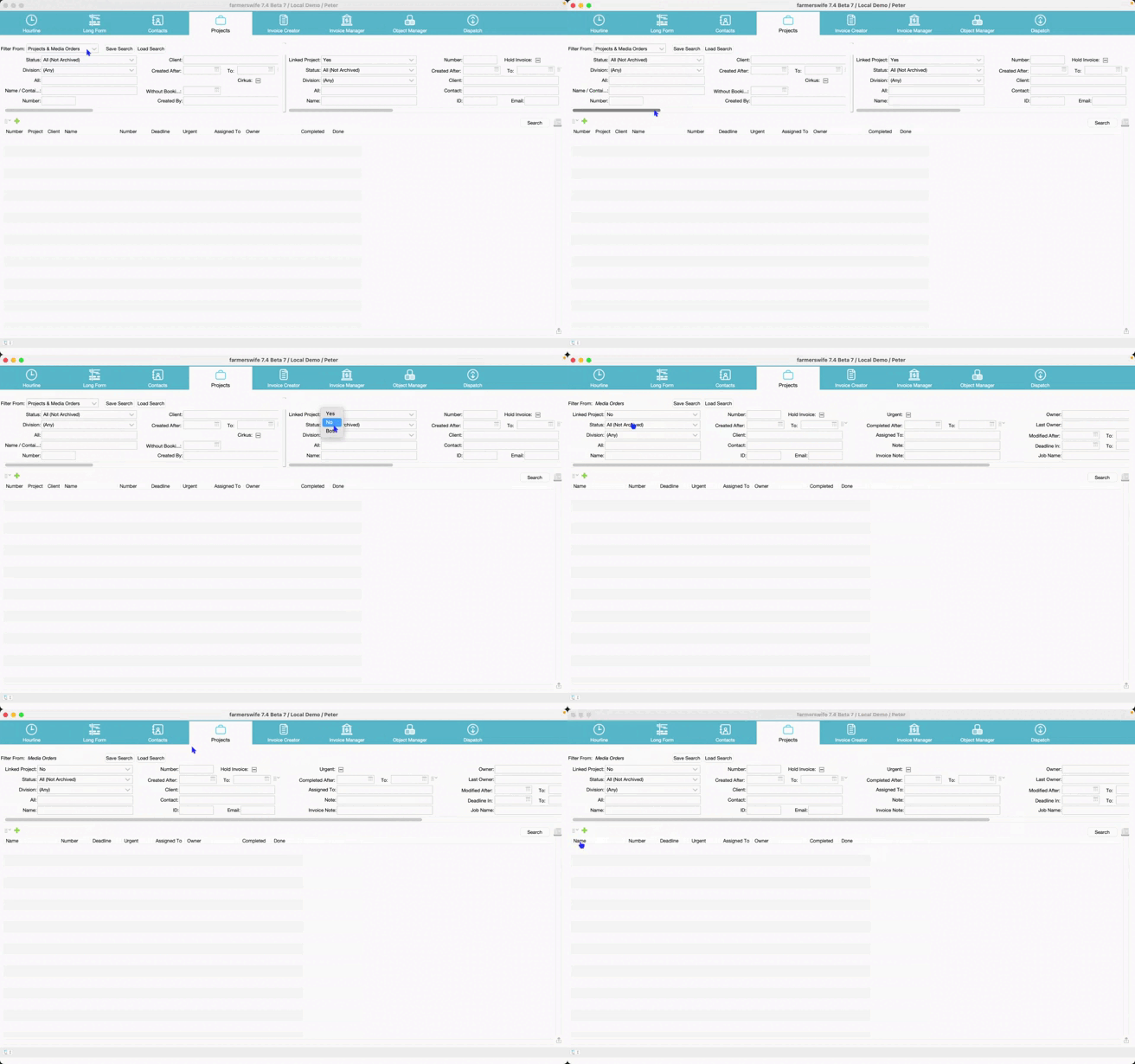
- Media Orders Linked to Projects: By default, this looks for Media Orders linked to Projects. If you change the "Linked Projects" toggle to No or Both, the interface will automatically hide the left Project pane and shift your primary scope directly to Media Orders. To search for Media Orders strictly within Projects, ensure "Linked Projects" is set to Yes.
Managing the Results Grid
The results grid will only show data matching the chosen search parameters. You can fully customize how this data is presented and sorted using the drop-down options menu icon located in the upper-left corner of the results grid area.
Choosing your columns (Edit View)
Select the Edit View option to open a configuration window where you can choose exactly which fields appear as column headers.
Move the fields you want to see to the Show pane, and move the fields you don't need to the Hide pane.

Column Sorting
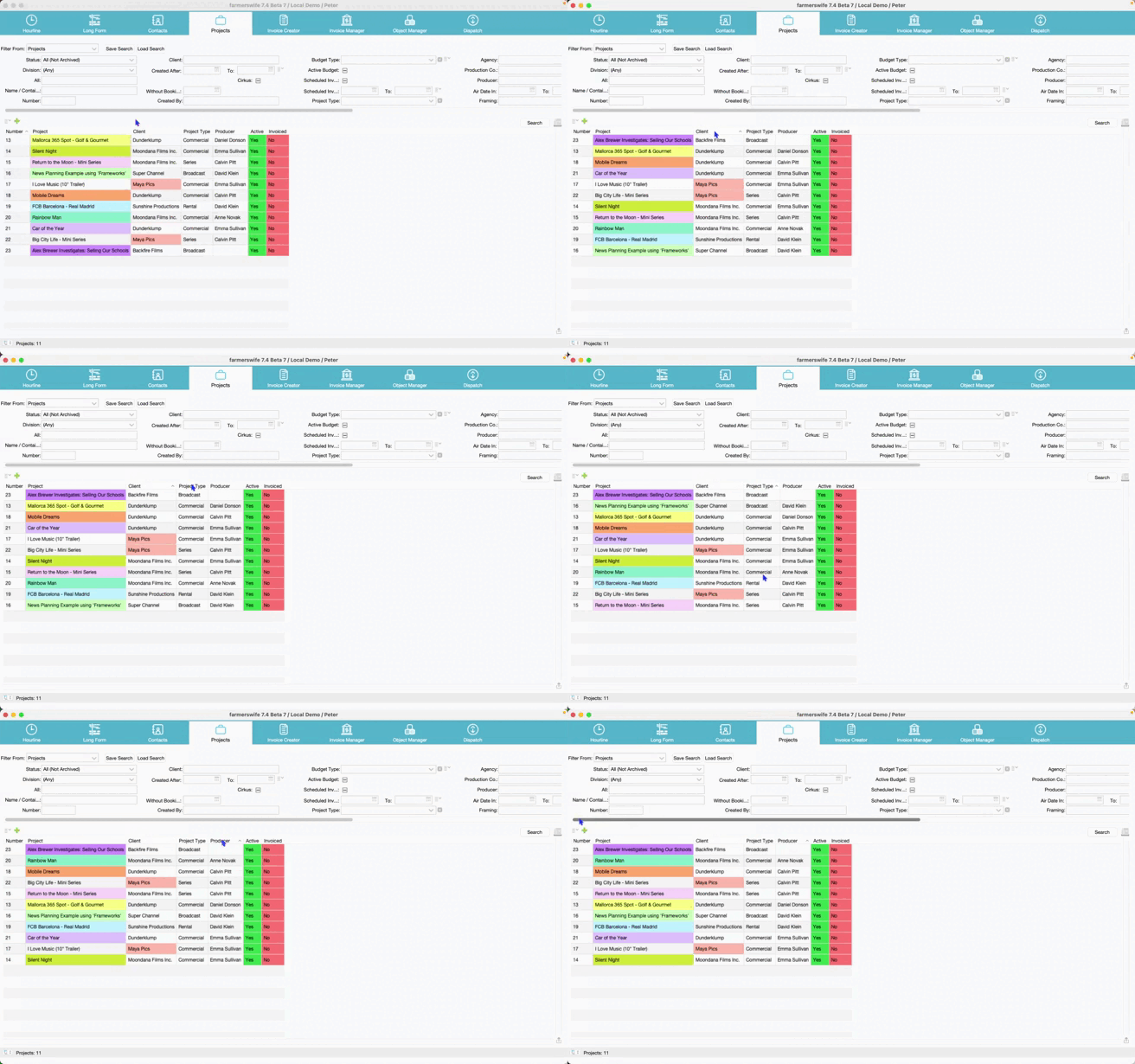
Click on any column header to sort your results grid by that field in ascending order. Click again to reverse to descending.
- Default view: By default, if no manual sorting is applied, farmerswife lists all search results chronologically by their Creation Date.
- Remove column sorting: To completely wipe out a sort priority, click on the drop-down options menu icon and choose Remove Column Sorting.
Layout formatting & widths
- Resizing widths: Click and drag the vertical borders of any column header to manually adjust its width so long text strings do not get cut off.
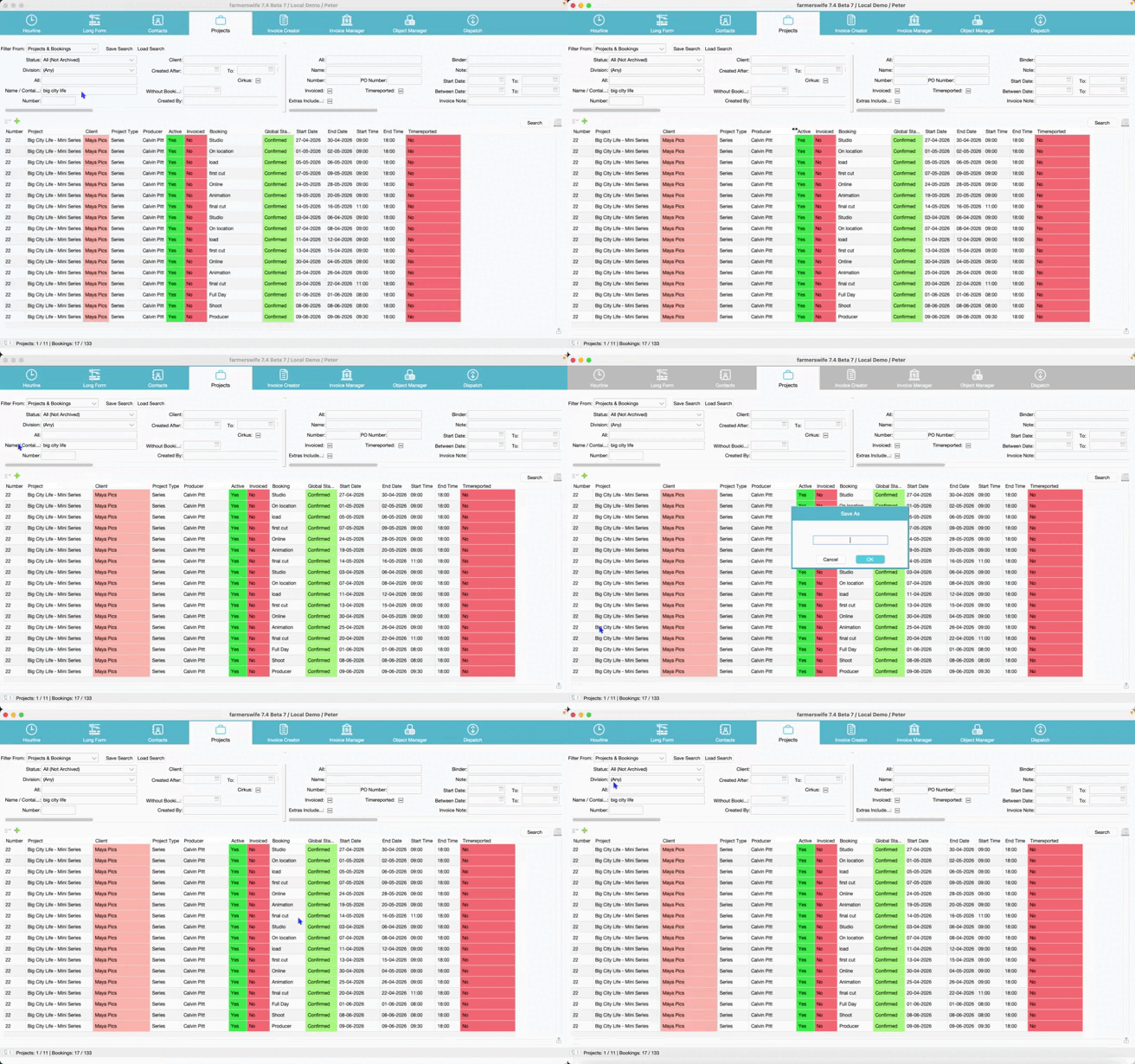
- Save View As: If you have spent time choosing columns and adjusting their ideal widths, use this option to save your column arrangement as a template layout so you can recall it instantly in the future.
- Load View: Reload a view template you previously built, or select Load View > [User Name] to use a custom layout template shared by one of your team members.
- Remove View: Cleans up your view library by permanently deleting any custom saved column templates you no longer need.
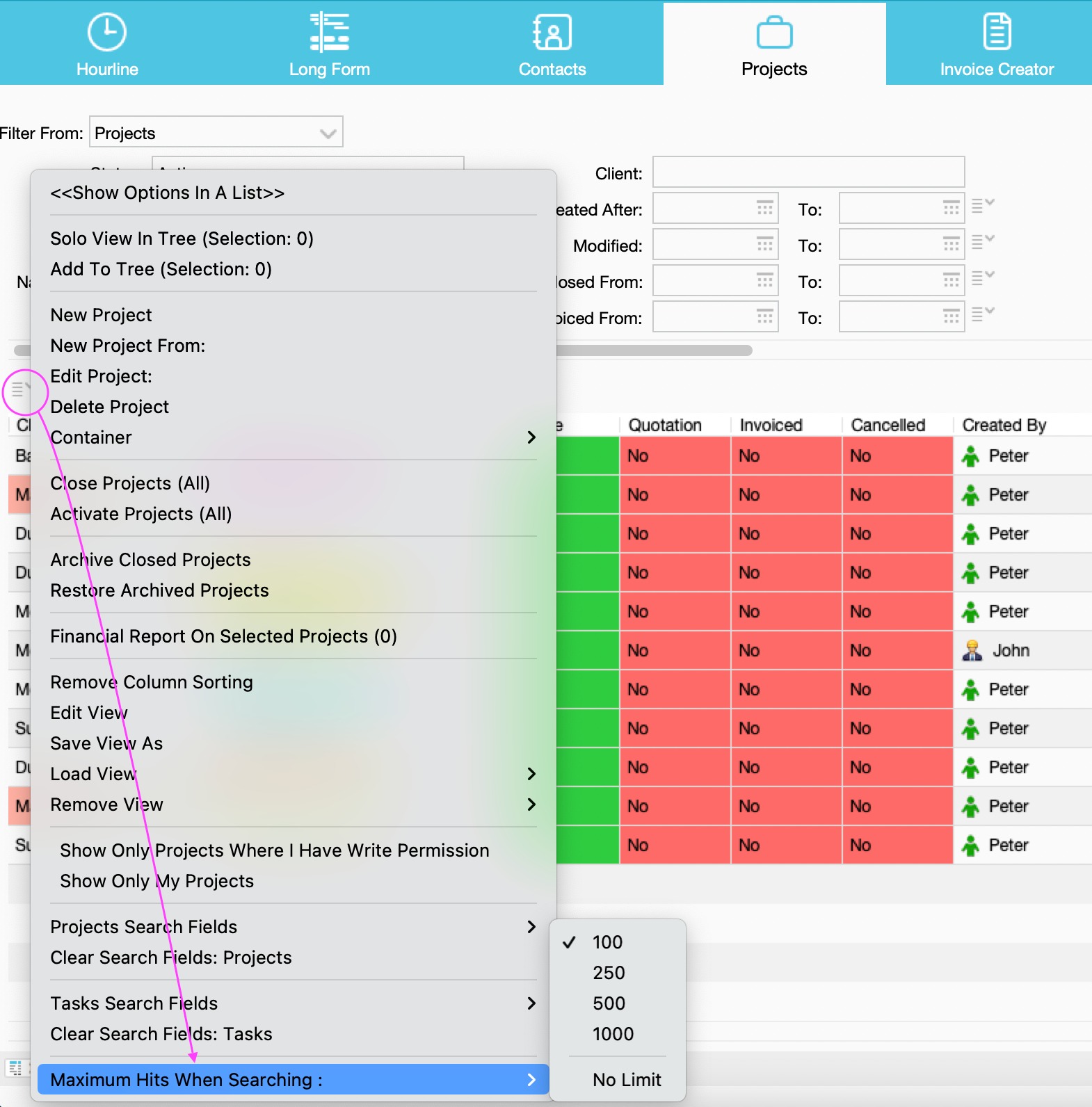
Maximum Hits
To prevent long database loading times, look for Maximum Hits When Searching in the options menu to cap your results.
Note: The system restores your server's default maximum hit limit next time you log in.
Saving your searches
If you build complex search filters and custom column views that you intend to reuse daily, you can save them as templates.
What is saved in a template
Every filter parameter entered in the top panel.
Your custom column widths.
Your active column sorting choices and directions.
Your configured Max Hits limit.
How to manage your saved templates
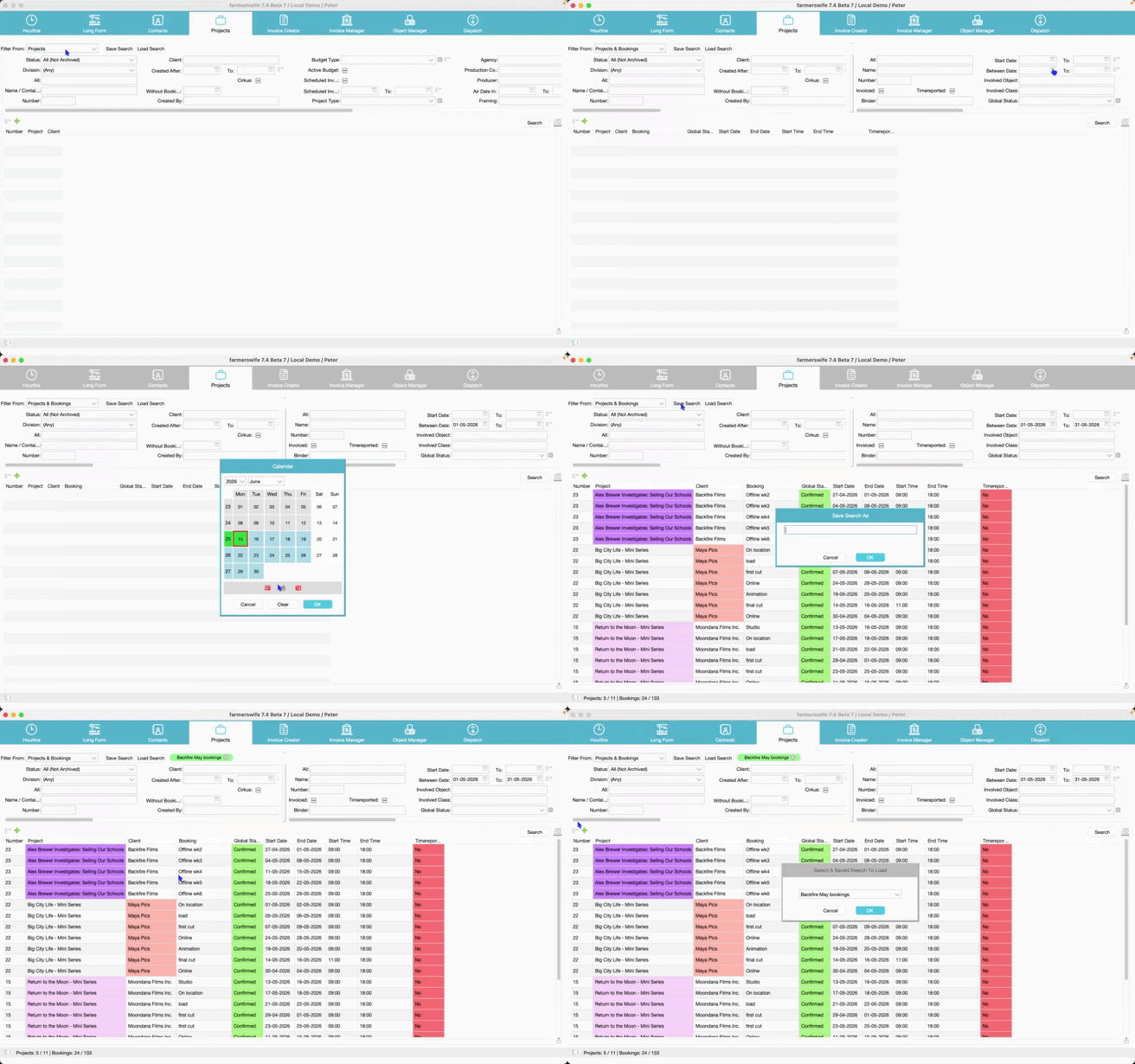
To Save: Click the Save Search button next to the Filter From dropdown (or choose Save Search from the right-click context menu). Name your template. The active template name will display right next to the button.
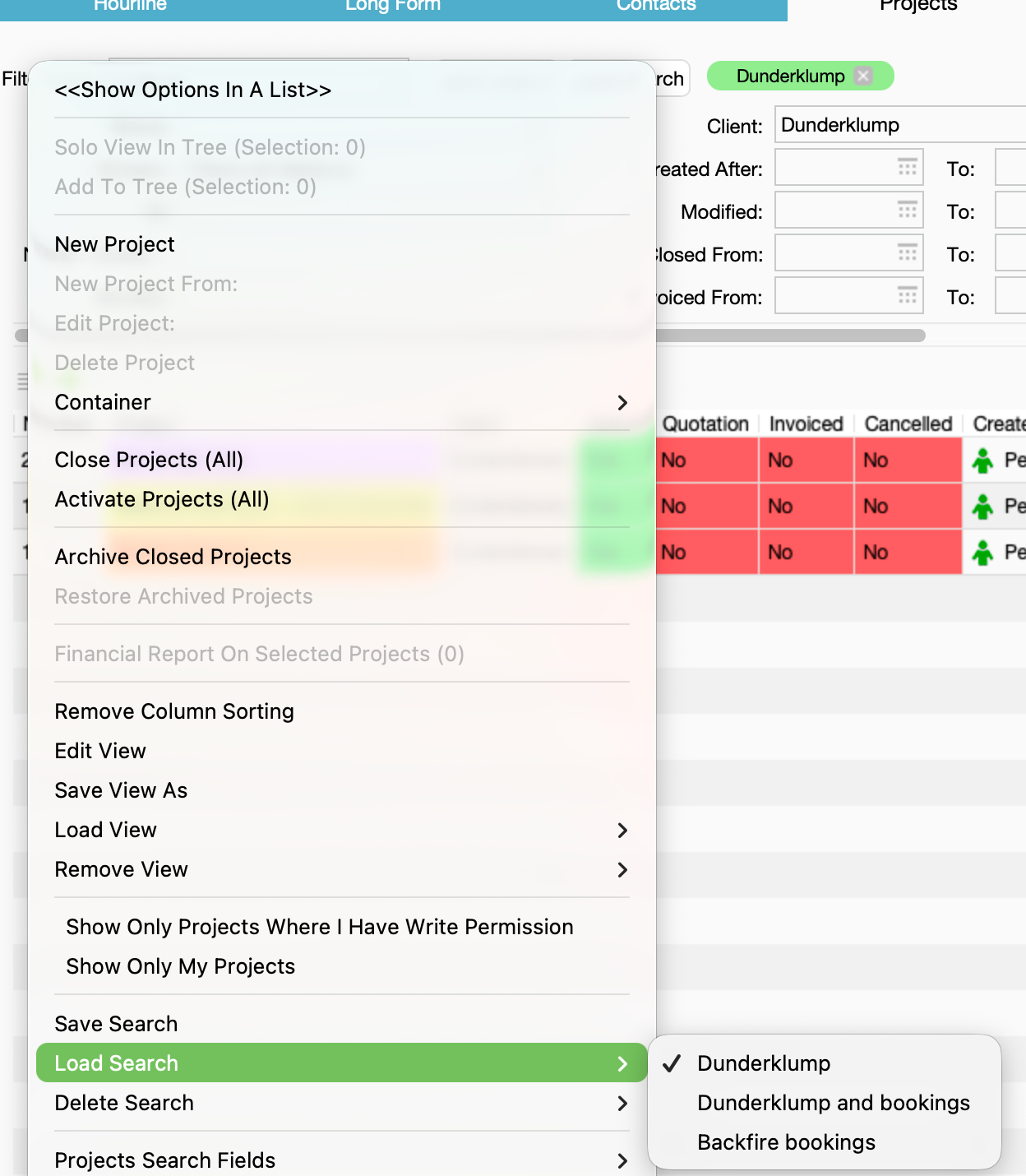
To Load: Click the Load Search button (or right-click context menu > Load Search) and select your template.
To Delete: Go to the right-click context menu > Delete Search and choose the template to wipe it out.
⚠️ Important Server sync behavior: When you load a saved search, that layout configuration is saved on the server for your user profile and will load automatically next time you open the app. To maximize speed, loading a search template only pre-fills the filters and columns—it does not automatically run the query. You must press Enter or click Search to get the results.
More menu Options
Right-clicking anywhere inside the results grid area (or Ctrl + Click on Mac) unlocks deep operations and bulk editing shortcuts. Many of these options dynamically show the number of items you have selected, displayed as (Selection: [amount]).
Project-related operations
View and navigation actions:
- Solo View In Tree (Selection: amount): Replaces whatever is currently in your Long Form Project Tree with your highlighted search results.
- Add To Tree (Selection: amount): Appends your highlighted search results to the bottom of your existing Long Form Project Tree list.
⚠️ Prerequisite note: The two options above will only appear in the menu after you have visited the Long Form screen at least once during your active session.
Project management and lifecycle actions:
- New Project: Opens a blank Project window to create a brand-new project.
- New Project From [Project name]: Clones the highlighted project. This creates a new project containing the exact same standard fields, custom metadata fields, and any attached budgets. Note: Bookings, Media Orders, Work Orders, etc. are not copied over.
- Edit Project [Project name]: Opens the standard configuration window for the highlighted project (you can also just double-click a row to open it).
- Delete Project: Permanently deletes the highlighted projects from the database.
- Container: Instantly attaches or detaches the selected project(s) to/from a Container, or edits the Container properties.
- Close Projects [Selection: amount]: Mass-updates the status of all highlighted projects to "Closed" (Active=No).
- Activate Projects (Selection: [amount]): Re-activates all highlighted closed projects, bringing them back into an active status.
- Edit Project Custom Field: Allows you to modify a custom metadata value across various projects simultaneously. farmerswife will display any custom field found on any of your selected projects, even if they originate from entirely different project templates. If a specific project in your selection does not use the chosen custom field, it is simply skipped automatically and remains safely untouched.
Archiving and financial operations:
- Archive Closed Projects: Scans the database to archive all projects that are marked as Closed.
- Archive Closed Projects (Selection: [amount]): Archives only the specific closed projects you have highlighted in your grid.
- Restore Archived Projects: Opens a management utility to safely pull archived projects back into the live system.
- Restore Archived Projects (Selection: [amount]): Restores only the specific archived projects selected in your grid.
- Financial Reports On Selected Projects (Selection: [amount]): Packages your highlighted projects and pushes them directly into the Financial Reports Financial Reports window.
Booking-related operations
These options appear when your search scope includes scheduling data (Bookings or Projects & Bookings).
- Edit Booking: Opens the window for the highlighted booking (you can also just double-click a row to open it).
- Edit Timereport/Extras: Opens the timereport window for the highlighted booking.
- Financial Reports On Selected Bookings ([amount]): Packages your highlighted bookings and pushes them directly into the Financial Reports Financial Reports window.
Bulk scheduling and status adjustment:
- Move Start Day For Selected Class Bookings [amount]: Shifts a group of bookings forward or backward on the calendar. It maintains the exact relative spacing (the "order" and gap times) between the bookings, using the first booking's new date as the anchor.
- Set Start Date For Selected Class Bookings[amount]: Collapses the schedule layout to move all highlighted bookings so they all begin on the exact same specified calendar date.
- Global Status For Selected Bookings: Mass-updates the workflow or confirmation status across all highlighted bookings simultaneously.
Booking bulk updates:
- Edit Name For Selected Bookings [amount]: Mass-renames the names of all highlighted bookings at once.
- Edit Checkpoint For Selected Bookings [amount]: Mass-assigns or updates checkpoints across all selected bookings simultaneously.
- Edit Custom Field For Selected Bookings [amount]: Modifies specific booking custom field metadata values across your highlighted rows at the same time. If a chosen field doesn't belong to a selected booking's template, that row is safely skipped.
Customizing Search Fields & Filter Views
Customizing filter fields
If you need to filter by metrics that aren't visible by default in your top Search Panel, you can add them manually via the grid options menu:
- Projects Search Fields: Determines which variables are displayed in the top Project Search pane and changes their layout order. Different arrangements can be saved and loaded based on your needs.
- Clear Search Fields: Projects: Instantly wipes out all text and values entered in your project search filters so you can start a fresh search.
- Bookings / Work Orders / Media Orders Search Fields: Determines which variables should be displayed in the top-right Search pane for Bookings, Work Orders, or Media Orders, and controls their layout order.
- Clear Search Fields: Bookings / Work Orders / Media Orders: Instantly clears up all values entered in any search fields related to Bookings, Work Orders, or Media Orders.

Workspace filters
- Show Only Projects Where I Have Write Permission: Used in combination with Project Permissions feature. Refer to the Project Permissions manual and the Force Hide Projects manual.
- Show Only My Projects: To display only Projects which have been created by the User.
Was this article helpful?
That’s Great!
Thank you for your feedback
Sorry! We couldn't be helpful
Thank you for your feedback
Feedback sent
We appreciate your effort and will try to fix the article